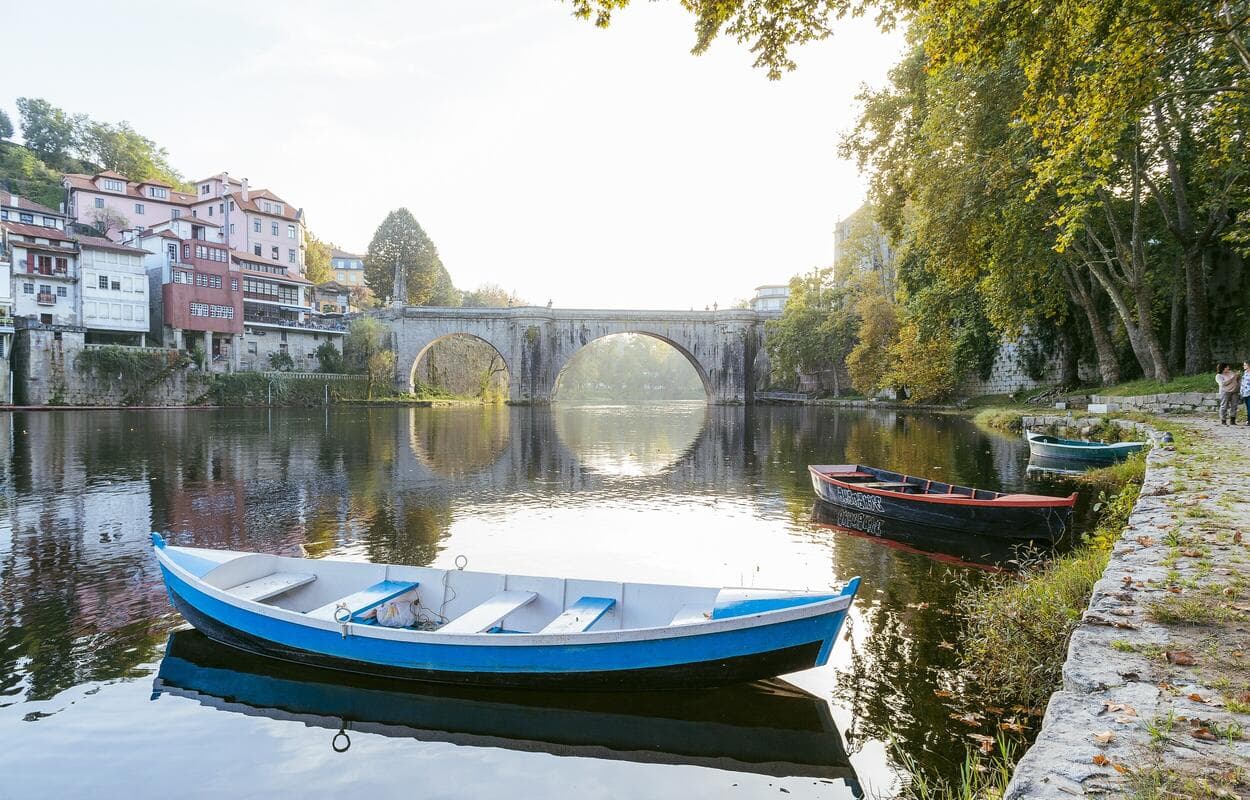
In Northern Portugal, crossed by the Tâmega River and nestled between the Marão and Aboboreira mountain ranges, lies a region where history and culture abound. Here is Amarante, possessing a vast heritage that invites you to explore and enjoy.
It is believed that the city and municipality owe their origin to primitive peoples who sought refuge in the Serra da Aboboreira – where dolmens and other archaeological remains abound – but another hypothesis is not ruled out: the influence of settlements dating back to the Roman period.
In the 12th century, a decisive step was taken. Queen Mafalda, wife of Afonso Henriques, is believed to have ordered the construction of the Albergaria do Covelo do Tâmega, similar to the Albergaria do Sobre Tâmega in Marco de Canaveses. More than just a shelter for travelers and the underprivileged, the Albergaria was born as a symbol of vitality for the region. The population around the building would grow. It was located on Rua 31 de Janeiro, having been demolished in 1939, where today you can sample some of Amarante's gastronomy. There was another inn in the city, located on the current Rua Pe. Paulino Cabral, dating from 1192.
But it is through the figure of Saint Gonçalo that Amarante goes beyond. Venerated by the people, the Dominican friar arrived in the region with evangelizing intentions and quickly became captivated by the land.
Much of Amarante's history is, in fact, due to the preacher. An example is the old medieval bridge, rebuilt by Saint Gonçalo himself, over the Tâmega River. This work, combined with the saint's fame, explains the strong influx of pilgrims to the territory and the population growth. At the same time, the birth of several monasteries and convents consolidated a region that, today, stands out as a true cultural center.
It is in homage to the friar that, in the 16th century, King John III authorized the construction of the Church of the Convent of São Gonçalo de Amarante, on the site of the original chapel where the preacher was supposedly buried. The convent is currently a tourist attraction enriched by Baroque architectural styles, among others; a must-see for any visitor.
The cannonball marks, still visible on the convent's facade, depict an episode of heroic Portuguese resistance. It was the year 1809 when, during the second French invasions, Napoleon Bonaparte's troops were held back for 14 days in their attempt to cross the São Gonçalo bridge, which connects the two banks of the Tâmega River.
History, arts, and literature are very present in a city that asserts a creative facet. After all, Amarante was the birthplace of geniuses who lent their talent to those areas. Names like Amadeo de Souza-Cardoso, Agustina Bessa-Luís, or Teixeira de Pascoaes will not, in fact, sound strange, even to the most distracted ears.
Participating in the city's festivities, and specifically the pilgrimage of São Gonçalo, is among the unmissable experiences for anyone visiting Amarante. And, among the approximately 302 square kilometers of a municipality dressed in the green of the landscape, the choice is difficult, given a very varied offer that includes golf, climbing, or bathing in the thermal spa.
Cultural and creative by nature, the city of Amarante gained even more prominence in October 2017 when it was classified by UNESCO as a Creative City of Music. As you will see on this website, there are many reasons why Amarante is a destination not to be missed in Northern Portugal.
Amarante stretches along rugged, verdant riverbanks, where the refreshing waters provide the perfect backdrop for strolling and appreciating the bucolic atmosphere that frames the river route. Beyond the Tâmega River, there are its tributaries – other waterways that also attract nature tourism: the Olo and the Odres. Water sports, picnics, or even discovering the villages surrounding the rivers are activities that promise to leave you longing for more. The Amarante Nautical Station is a network of partners offering nautical tourism, integrating the nautical resources present in the territory, including accommodation, restaurants, and nautical activities.

Estação Náutica de Amarante holds the official recognition awarded by the Portuguese Nautical Stations Network. View the certificate and accreditation details.
View certificate
Fórum Oceano is the managing entity of the Portuguese Sea Cluster, certified and recognised by the Ministry of Economy and Sea, Ministry of National Defence, and Ministry of Planning and Infrastructure.
UPTEC Mar, sala C2, Av. da Liberdade S/N 4450-718 Leça da Palmeira – Portugal
Copyright @ 2026 Nautical Stations of Portugal. All rights reserved. Developed By Yacooba Labs.


